What Is a Dumb Phone for Kids? The Parent's Guide to Choosing Less

By Pundarik Ranchhod, Kite Inclusive
Published: 4 May 2026 · 10 min read

As parents of a soon to be Year 7 child, we are in the middle of the smartphone dilemma. Even though our son knows our very clear position on smartphones, he still asks the question. I think he does that just to check that we have not changed our minds!
I also get many parents, friends and family members asking for advice on the different options available these days. It is a space that is increasingly getting attention.
What a dumb phone is
A dumb phone is a mobile handset that makes calls, sends texts, and does nothing else. No apps. No browser. No social media. No notifications pulling a child's eyes back to the screen every forty seconds. The two most common models in the UK are the Nokia 105 and the Nokia 2660 Flip, both available for £20–£30 from any high street retailer or supermarket.
Pair one with a Pay-As-You-Go SIM card at £5–£10 a month and the child has a working phone by teatime.
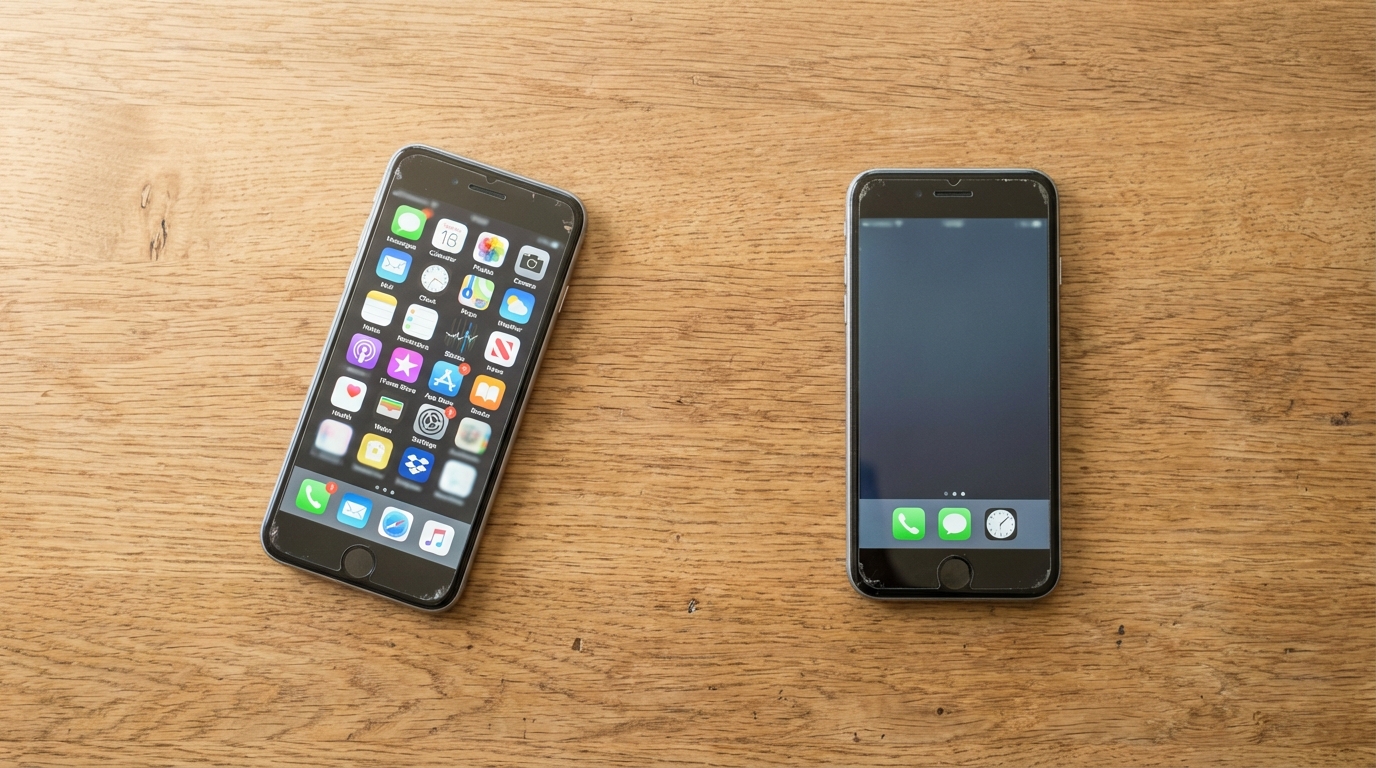
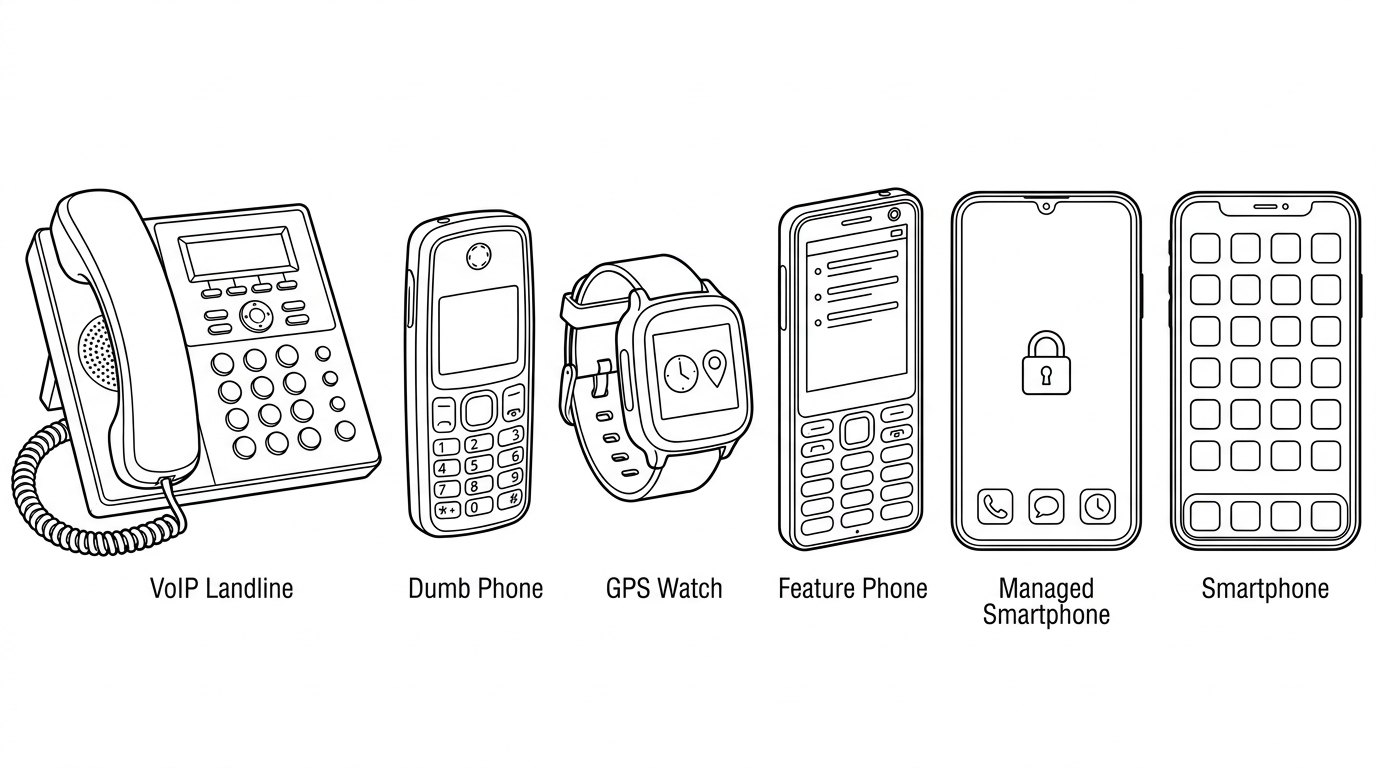
A dumb phone is not a feature phone, which may include a basic browser or WhatsApp. It is not a managed smartphone like Pinwheel, Bark Phone or The Other Phone, which run modified operating systems with parental dashboards. It sits close to the bottom of the connectivity spectrum — the basic mobile communication device. It calls. It texts. It stops.
What happens when a smartphone is in the room
In 2017, researchers at the University of Texas at Austin ran an experiment that changed the way cognitive scientists think about phones. They asked participants to complete tasks measuring working memory and fluid intelligence — the mental resources that support focus, problem-solving, and learning. Some participants left their phones in another room. Others kept them on the desk, face-down and switched off.
“The brain was spending attentional resources resisting the gravitational pull of a device it had learned to treat as permanently relevant.”
The participants whose phones were in another room performed measurably better. Not because they were distracted — nobody reported thinking about their phone. Not because they received notifications — the phones were silent. The effect operated below conscious awareness. Ward et al. called this “brain drain”: the mere presence of a smartphone occupies cognitive capacity that would otherwise be available for the task at hand.
The effect was strongest for people most dependent on their devices. Those who relied on their phones the least showed no measurable cognitive cost at all.
Jonathan Haidt draws on this research in The Anxious Generation to make a developmental argument. Children aged 5–11 are building the prefrontal cortex systems responsible for impulse control, sustained attention, and decision-making. These systems are still under construction. A device that passively drains cognitive capacity during this developmental window carries a cost that no parental control setting can address, because the cost is triggered by the phone's presence rather than its use.
A dumb phone does not produce this effect. It has no apps generating anticipation, no notifications creating reward loops, no algorithmic content competing for attention. When a child puts down a Nokia 105, the device becomes inert. There is nothing to resist. The attentional cost drops to zero.
The Year 7 dilemma
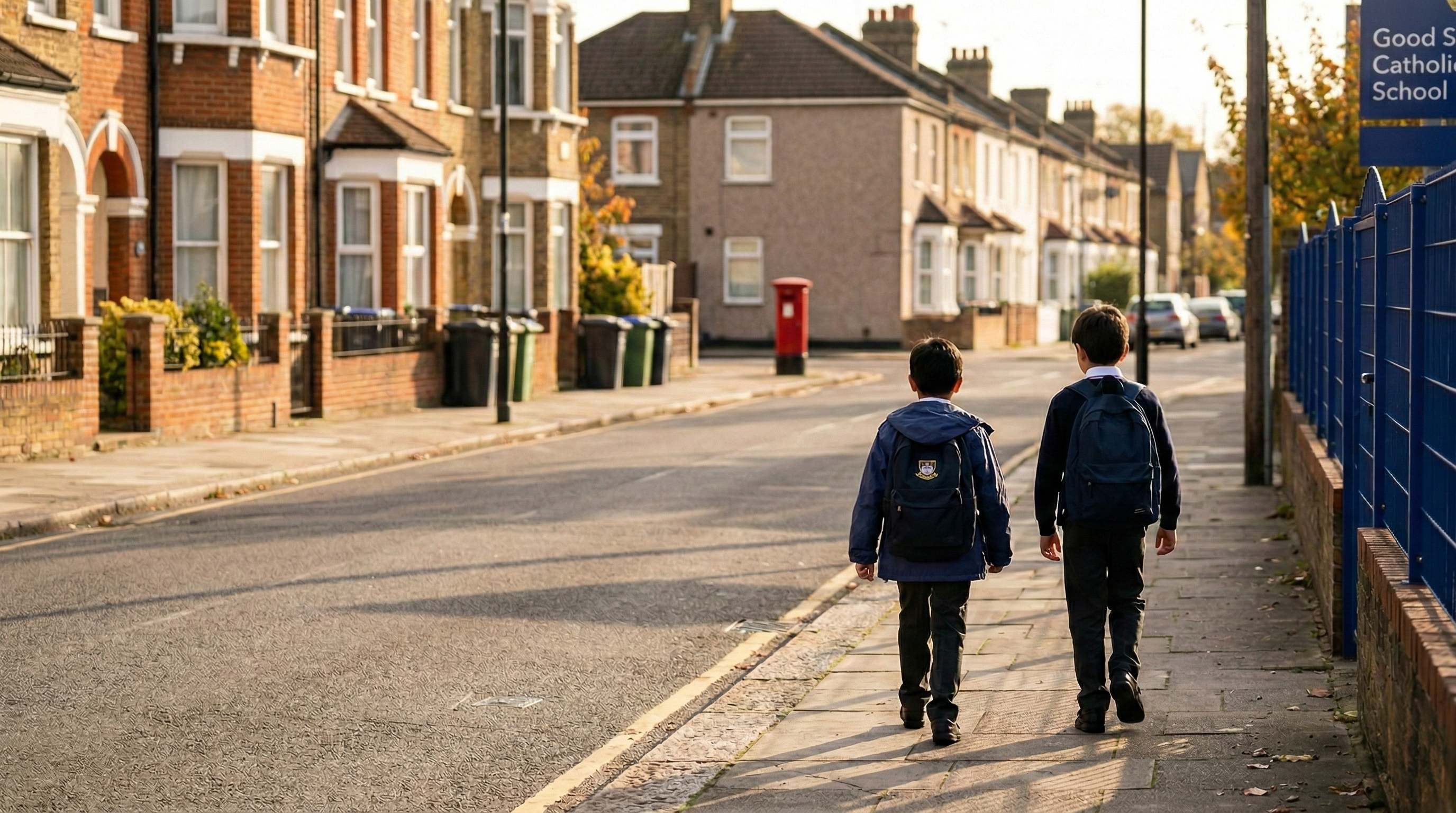
The summer between Year 6 and Year 7 compresses every parenting anxiety about technology into a single decision. The child is about to start secondary school. The WhatsApp group chat for the new form hasn't been created yet, but it will appear within weeks of September. The child reports that everyone else will have a phone. The parent doesn't know whether that is true.
The pressure is real. The timeline is negotiable.
A dumb phone solves the immediate logistical problem. The child can call if they miss the bus, text when they arrive at school, reach a parent after football practice. It handles the communication need that parents are trying to address when they consider buying a phone in the first place.
It does not solve the social problem. The child cannot join the WhatsApp group. They cannot receive memes. They cannot participate in the digital social layer that Year 7 often builds around messaging platforms. This cost is real and should not be dismissed.
“A dumb phone buys something that a smartphone purchase does not: time. The child enters secondary school with a phone in their pocket that handles communication without exposing them to social media, algorithmic content, or the cognitive presence effect.”
But the dumb phone buys something that a smartphone purchase does not: time. The parent retains the option to upgrade to a managed smartphone after observing how the first term unfolds — checking if the social cost is real or imagined, whether the child's specific peer group requires smartphone access, and whether the school's phone policy makes the question irrelevant.
The Smartphone Free Childhood pact model strengthens this strategy. If six families in the same year group agree to delay smartphones together, the social isolation evaporates. The child isn't the odd one out. They are part of a group that chose differently, and that group provides its own social proof.
The school phone ban and why it matters for dumb phones
The government has tabled an amendment to the Children's Wellbeing and Schools Bill that will make existing phone-free guidance statutory. The January 2026 guidance from the Department for Education states that all schools should be mobile phone-free environments by default. Ofsted began inspecting schools' mobile phone policies from April 2026. The direction is clear: smartphones have no place in the school day.
Most schools will respond by introducing phone pouches or lockers. These are storage systems that keep smartphones out of sight during lessons. Guy Holder, Head of PSHE and co-founder of Set@16, argues this is the worst possible outcome for families trying to delay smartphones.
If a school puts phone pouches on its September kit list, it sends a direct signal to every Year 6 parent: your child needs a smartphone. Storage systems institutionalise smartphone ownership at exactly the age when parents are making the decision. They embed the tipping point between primary and secondary school rather than challenging it.
“Schools should ban smartphones from premises entirely, not store them, because most smartphone harms happen outside school hours.”
Holder's position is that schools should ban smartphones from premises entirely, not store them, because most smartphone harms happen outside school hours. A phone locked in a pouch during lessons does nothing about the bus home, the walk to the park, or the hours between four o'clock and bedtime.
A dumb phone sidesteps the storage problem entirely. It needs no pouch, no locker, no enforcement mechanism, because it is not a distraction device. A Nokia 105 in a school bag does not trigger the cognitive drain effect, does not contain social media, and does not require Ofsted to inspect its storage arrangements. Schools that ban smartphones from premises while permitting basic communication devices give parents the clearest possible signal: delay the smartphone, carry a brick.
Give your child a phone without the screen
Kite Phone lets children call friends and family from home with zero screen time. A perfect complement to a dumb phone for out-of-home use.
Get Your Kite PhoneWellbeing: dumb phone vs smartphone for ages 5–11
The evidence base for delaying smartphones has grown substantially since Haidt published The Anxious Generation. Depression rates among adolescents increased between 2010 and 2020 on a trajectory that tracks smartphone adoption. Children aged 8–10 now average over five hours of daily entertainment screen time. The design features driving this — infinite scroll, push notifications, social validation metrics, and recommendation algorithms — are present on every smartphone regardless of what parental controls are applied on top.
Parental controls do not address the underlying mechanism. They limit duration but leave the architecture of addiction intact. Algorithms, infinite scroll, and social validation features function identically within allowed time windows. By ages 10–11, bypass rates for parental controls reach 60–80% through factory resets, VPN apps, secondary accounts, and friends' devices.
A dumb phone eliminates the mechanism rather than attempting to manage it. No infinite scroll. No push notifications. No social validation metrics. No recommendation algorithms. No app store. No browser. The device performs two functions and is otherwise inert. The child cannot develop the device dependence that amplifies the brain drain effect because there is nothing on the device to create dependence.
The primary cost is social. A child carrying a dumb phone in a smartphone-dominant peer group may face questions about why their phone is different. This is a real cost. It is also a social engineering problem that collective action can solve — through Smartphone Free Childhood pacts, through school policies that support basic phones, through the growing number of families choosing the same path. It is not a neurological vulnerability baked into the hardware.
“The evidence supports delaying smartphone access and providing simpler devices during the developmental window when executive function is still forming.”
What a dumb phone doesn't solve
No GPS tracking. The parent cannot see the child's location on a map. For children aged 5–8 who are rarely out of adult supervision, a GPS watch like Xplora may be more appropriate — it provides location tracking and approved-contact calling on the wrist.
No content filtering. Incoming texts and calls are unmonitored. There is no parental dashboard showing who contacted the child or what was said.
No emergency SOS with automatic location sharing. Unlike GPS watches, a dumb phone does not send the child's coordinates to a parent when an SOS button is pressed. The child must call and verbally communicate where they are.
The T9 keypad is a friction point. A child raised on smooth glass will find pressing the number seven four times to type the letter 's' genuinely frustrating. Most children give up texting and call instead — which may be a feature rather than a flaw!
Some models marketed as basic phones include a rudimentary browser or WhatsApp capability. Check the specific model before purchase. The Nokia 105 4G has no browser and no WhatsApp. The Nokia 2660 Flip may include limited internet capability depending on the variant. If the goal is zero internet access, verify the specification.
For home-based calling without any portable device at all, a VoIP landline phone eliminates the portable screen entirely. A dumb phone occupies the specific gap between a GPS watch and a managed smartphone: out-of-home communication for children old enough to carry a device independently but too young, or deliberately delayed, for a smartphone.
There is a full comparison of every option, including pricing and feature grids, in the guide to every phone alternative for UK children compared.
Recommended models and costs
Cost comparison over three years
| Device | Hardware | Monthly | 3-year total |
|---|---|---|---|
| Nokia 105 4G | ~£20 | £5–£10 | ~£200–£380 |
| Nokia 2660 Flip | ~£30 | £5–£10 | ~£210–£390 |
| Nokia 3210 (2024) | ~£60 | £5–£10 | ~£240–£420 |
- Nokia 105 4G: Calls/texts only, FM radio, torch, no camera, no browser
- Nokia 2660 Flip: Flip form factor, basic 0.3MP camera, FM radio
- Nokia 3210 (2024): Basic camera, Snake, limited browser, nostalgia factor
Nokia 105 4G. Approximately £20. Calls and texts only. FM radio. Torch. No camera. No browser. No WhatsApp. Battery lasts several days on a single charge. The most stripped-back option available in the UK.
Nokia 2660 Flip. Approximately £30. Flip form factor that younger children find satisfying to open and close. Basic 0.3MP camera. FM radio. Check the specific variant for internet capability — some include a rudimentary browser that undermines the zero-internet proposition.
Nokia 3210 (2024 reissue). Approximately £60. Basic camera. Snake. No social media. Limited browser. More expensive than necessary if the objective is pure communication, but the nostalgia factor appeals to some parents.
All models are unlocked and work with any UK carrier. No contract required. A PAYG SIM from any network costs £5–£10 per month or less with light usage. Total first-year cost: £80–£150 depending on model and usage pattern.
The broader picture
A dumb phone is not the final answer. It is a deliberate, time-limited strategy that gives a child basic communication while preserving the developmental window that Haidt identifies as critical. Some families use one for two years and then transition to a managed smartphone when the child demonstrates readiness. Others pair it with a landline home phone so the child has social calling at home and basic reachability outside. Others find the child never asks for more.
The right combination depends on the child's age, the school's phone policy, and the behaviour of the peer group. The SFC pact model reduces the social cost of choosing less. The school phone ban, if implemented as a premises ban rather than a storage system, reinforces it.
The broader context — the parent-led movement, the government response, and the school-gate pacts that make these decisions easier — is covered in the guide to the UK parents' movement to delay smartphones.
For parents who decide to transition to a managed device later, the step-by-step iPhone lockdown guide covers every setting.
Frequently Asked Questions
Related Guides
Best First Phone for Kids UK 2026: GPS Watches vs Dumb Phones vs WiFi Landlines Compared
19 Mar 2026 · 12 min read